Grain Valley High School
Little Women
Review by Cappies Critics
Published on 4/16/2026
A SHOW THAT TELLS A STORY - A REAL ONE
by Marin Heide of Blue Springs South High School
Society's expectations, the power of family, and the desire to be one of the greats: Grain Valley High School delivers on all these themes and more in their performance of LITTLE WOMEN. From laughing to sobbing, this show reminds the audience that while stories help us escape into fantasy, they can also ground us in the fragility of real life. Grab a notebook and join Jo March as she writes her way through sisterhood.
Kate Hamill's adaptation of LITTLE WOMEN follows the March family in 1860s New England as the women of the family grow up, grow apart, and grow closer. Protagonist and daughter Josephine, or Jo, tries to chase her dreams and embrace who she truly is. As a girl who is constantly reminded of her boyish ways, Jo feels excluded from her "ladylike" sisters and misunderstood by the men around her. She strives to be an author but feels restricted by society at the time. Additionally, Jo wishes to go back to the simpler time of childhood. She doesn't want anything to change, and why would she? When she was young, all her sisters were close, their neighbor Laurie was the closest friend she had, and the future was a bright star in the distance. But as life keeps coming at her, Jo must decide what to let go of and what to chase, all the while trying to cherish the family she has.
The actors are the backbone of this show, and some actors in particular shine on the stage. Brooklyn Hedrick and her portrayal of Amy March is on point with her strong characterization, comedic timing, and understanding of character development. There is never a line of subtext Hedrick doesn't understand, nor an argument where she doesn't flourish. Similarly, Dylan Rucinski's characterization of Laurie is fantastic and demonstrates his skillful blend of talents from comedy to drama. His physicality adds a whimsical strength to Laurie that makes him impossible to hate. While some actors lack dimension in their performances, many of the leads made up for this through their commitment and chemistry. As a whole, the cast works elegantly to depict the complex motivations of every character.
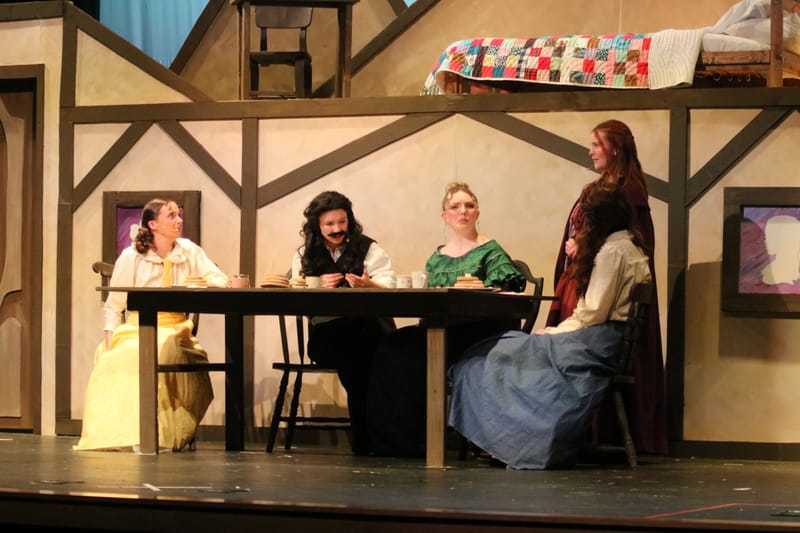
At first glance, the set stands out with its bold angles and multiple levels. Scenic Designer Bailey DeLaMare sends the audience into the home of a struggling family using cool-toned wood and minimal decorations, which creatively flip and twist depending on the current setting. The sound crew, led by Chase Watson, works hard to hit every cue and is on top of keeping the microphones on at the correct times. Throughout the whole show, the sound levels never suffer and are handled delicately. At times, the lighting crew struggled with timing and accuracy, but the mood they established throughout the show adds depth to the performance.
Whether the cast is fiercely arguing about their place in life or the crew is seamlessly moving set pieces, Grain Valley High School's production of LITTLE WOMEN is a classic performance of the renowned show. As Jo struggles to discover who she is, her sisters remind her of something we all need to hear sometimes: that what makes her unique is what makes her strong. As the curtains close, Jo decides to write another story: and maybe, this time, it will be a real one.
A VIBRANT MARCH
by Halia Ivory of Lee's Summit North High School
GRAIN VALLEY'S LITTLE WOMEN comes to life as a heartfelt portrayal of the story of four sisters discovering the ups and downs of life.
Originally written by Louisa May Alcott in 1868, LITTLE WOMEN has become a classic story that has been adapted into various forms of media, including over a dozen on-screen adaptations, a musical, a play, a ballet, and an opera.
From the very beginning, each sister is rooted with their own unique standing while still feeling deeply connected to one another. The relationships between characters are clear and authentic, allowing the story to feel personal and engaging throughout. Costumes, designed by Theo Hontz, play a wildly important role in the telling of this story. Each sister is represented by a specific color that reflects her personality and growth. Jo is dressed in a bold, vibrant red, showing her passion and strong will. Amy is associated with yellow, which later shifts to a dusty purple as she matures and strives to present herself as more refined. Meg is displayed in green, which is later mixed with more and more brown as she steps into married life in Act Two. Beth, however, remains in blue throughout the show. This choice is especially meaningful as it reflects Beth's desire to stay the same. While her sisters grow and change, Beth remains content with her life at home and shows no desir
e to seek anything more. Her unchanging costuming quietly displays how deeply comforted she is by her family just the way it is, making her character all the more touching.
Laci Stoneburner's portrayal of Jo March stands out as a driving force in the production. Stoneburner displays Jo's creativity and independence, especially when Jo is acting out moments from her play. In these scenes, Jo is shown as perfectly in her element, as if she's stepped into her own little world. Beyond that, Stoneburner shows strong connections with every character on stage. With Amy, we see a realistic sibling feud, while her interactions with Laurie, played by Dylan Rucinski, feel natural and friendly, almost like siblings. At the same time, her softer moments with Beth reveal a caring and protective side. Throughout the performance, Stoneburner remains consistent, making every line feel intentional and meaningful.
Brooklyn Hedrick brings energy and humor to the role of Amy March. Her comedic timing is sharp, and her reactions to the people around her are always engaging, often adding extra life to each scene. In the first act, Hedrick fully embraces Amy's childish behavior, making her both amusing and believable. As the story moves into the second act, she shows Amy's growth into a more mature young woman. However, Hedrick does not lose sight of Amy's younger self. In certain moments, especially when interacting with Jo, glimpses of that same childish personality return, adding depth to her performance. This balance between growth and familiarity makes Amy's character feel real and well-developed.
GRAIN VALLEY'S LITTLE WOMEN is a strong and thoughtful production that highlights the importance of family, growth, and identity. Through detailed costuming and committed performances, the story of the March sisters is brought to life in a way that feels both classic and fresh.
GRAIN VALLEY'S LITTLE WOMEN: A TRIBUTE TO A CLASSIC
by Jadynne Brady of Blue Springs South High SChool
Have you ever felt like you are out of place? That you do not fit the expectations that everyone has put on you? That while your sisters are flourishing as flowers, you are a rock? Perhaps that last one is unique, Jo March, in Grain Valley High School's LITTLE WOMEN.
Set in the early 1860's during the time of the Civil War, this play is an adaptation of the famous novel by Louisa May Alcott, which follows the four March daughters: Jo, Beth, Amy, and Meg. Throughout an ever-changing political climate, this production tackles themes of feminism, class, and the inevitability of change. As Jo watches her sisters grow up, she continues to struggle with her identity and place in the world as an aspiring writer who doesn't fit the mold of a traditional "lady."
As the lights go up on stage, we see Brooklyn Hedrick's Amy March, and are immediately transfixed by her spoiled characterization that Hedrick has perfected. Her bratty attitude and immature thinking are conveyed with dramatic eye rolls, sighs, and girlish squeals. However, Amy isn't always this shallow. By the time Act II rolls around, we can see that Amy has aged, not just with the costume change, but in her physical acting. Hendrick holds herself differently and speaks with more purpose, showing the maturity time has brought. Indeed, the importance of physicality in acting is shown again with Dylan Rucinski's portrayal of Laurie. Another actor who took the stage by storm, his chemistry with each person in a scene makes you truly believe that he is in love with his tomboy neighbor. From theatrically "dying" on stage during one of Jo's plays to nearly shedding a tear when he confesses his love to Jo, the range of Rucinski's emotional depth is clear. While at times, it seemed
that some actors were simply reciting a memorized script instead of acting, LITTLE WOMEN picks right back up, especially with Meg's monologue. The way that Hadasah Trotter delivers these struggles as a poor, young mother, the audience is immersed in the story.
If we pull up to the booth, the lighting crew is the one turning on the lights. The lighting on the cyc was a clear indicator of the thought that was put into the lighting design. While in the March house, the backdrop was usually blue, and in the Laurence home, beige. Even at Christmas time, the cyc became a festive evergreen. Even the lighting choices when focusing on the attic or the entire stage immersed the audience into the scene without it being too noticeable. What was noticeable, however, was the curtains. There were numerous times, especially during transitions, when the side curtains were pulled back too far and allowed a nearly full view of backstage. Those instances were made up for with the costuming. Each daughter's dresses were a pop of color, making them both stand out from the rest of the cast and each other. Theo Hontz's executive decisions about what characters wore what, including many of Laurie's outfits, and their attention to detail both emphasized the
time period while also highlighting each of the characters' personalities.
This production does a wonderful job of portraying the themes that are found in the original novel. Each character's choices show how difficult it is to be different than those around you while also feeling resistant to change and growing up. And when the curtain closes on Grain Valley High School's LITTLE WOMEN, we can find truth in that "nothing lasts forever."
by Marin Heide of Blue Springs South High School
Society's expectations, the power of family, and the desire to be one of the greats: Grain Valley High School delivers on all these themes and more in their performance of LITTLE WOMEN. From laughing to sobbing, this show reminds the audience that while stories help us escape into fantasy, they can also ground us in the fragility of real life. Grab a notebook and join Jo March as she writes her way through sisterhood.
Kate Hamill's adaptation of LITTLE WOMEN follows the March family in 1860s New England as the women of the family grow up, grow apart, and grow closer. Protagonist and daughter Josephine, or Jo, tries to chase her dreams and embrace who she truly is. As a girl who is constantly reminded of her boyish ways, Jo feels excluded from her "ladylike" sisters and misunderstood by the men around her. She strives to be an author but feels restricted by society at the time. Additionally, Jo wishes to go back to the simpler time of childhood. She doesn't want anything to change, and why would she? When she was young, all her sisters were close, their neighbor Laurie was the closest friend she had, and the future was a bright star in the distance. But as life keeps coming at her, Jo must decide what to let go of and what to chase, all the while trying to cherish the family she has.
The actors are the backbone of this show, and some actors in particular shine on the stage. Brooklyn Hedrick and her portrayal of Amy March is on point with her strong characterization, comedic timing, and understanding of character development. There is never a line of subtext Hedrick doesn't understand, nor an argument where she doesn't flourish. Similarly, Dylan Rucinski's characterization of Laurie is fantastic and demonstrates his skillful blend of talents from comedy to drama. His physicality adds a whimsical strength to Laurie that makes him impossible to hate. While some actors lack dimension in their performances, many of the leads made up for this through their commitment and chemistry. As a whole, the cast works elegantly to depict the complex motivations of every character.
At first glance, the set stands out with its bold angles and multiple levels. Scenic Designer Bailey DeLaMare sends the audience into the home of a struggling family using cool-toned wood and minimal decorations, which creatively flip and twist depending on the current setting. The sound crew, led by Chase Watson, works hard to hit every cue and is on top of keeping the microphones on at the correct times. Throughout the whole show, the sound levels never suffer and are handled delicately. At times, the lighting crew struggled with timing and accuracy, but the mood they established throughout the show adds depth to the performance.
Whether the cast is fiercely arguing about their place in life or the crew is seamlessly moving set pieces, Grain Valley High School's production of LITTLE WOMEN is a classic performance of the renowned show. As Jo struggles to discover who she is, her sisters remind her of something we all need to hear sometimes: that what makes her unique is what makes her strong. As the curtains close, Jo decides to write another story: and maybe, this time, it will be a real one.
A VIBRANT MARCH
by Halia Ivory of Lee's Summit North High School
GRAIN VALLEY'S LITTLE WOMEN comes to life as a heartfelt portrayal of the story of four sisters discovering the ups and downs of life.
Originally written by Louisa May Alcott in 1868, LITTLE WOMEN has become a classic story that has been adapted into various forms of media, including over a dozen on-screen adaptations, a musical, a play, a ballet, and an opera.
From the very beginning, each sister is rooted with their own unique standing while still feeling deeply connected to one another. The relationships between characters are clear and authentic, allowing the story to feel personal and engaging throughout. Costumes, designed by Theo Hontz, play a wildly important role in the telling of this story. Each sister is represented by a specific color that reflects her personality and growth. Jo is dressed in a bold, vibrant red, showing her passion and strong will. Amy is associated with yellow, which later shifts to a dusty purple as she matures and strives to present herself as more refined. Meg is displayed in green, which is later mixed with more and more brown as she steps into married life in Act Two. Beth, however, remains in blue throughout the show. This choice is especially meaningful as it reflects Beth's desire to stay the same. While her sisters grow and change, Beth remains content with her life at home and shows no desir
e to seek anything more. Her unchanging costuming quietly displays how deeply comforted she is by her family just the way it is, making her character all the more touching.
Laci Stoneburner's portrayal of Jo March stands out as a driving force in the production. Stoneburner displays Jo's creativity and independence, especially when Jo is acting out moments from her play. In these scenes, Jo is shown as perfectly in her element, as if she's stepped into her own little world. Beyond that, Stoneburner shows strong connections with every character on stage. With Amy, we see a realistic sibling feud, while her interactions with Laurie, played by Dylan Rucinski, feel natural and friendly, almost like siblings. At the same time, her softer moments with Beth reveal a caring and protective side. Throughout the performance, Stoneburner remains consistent, making every line feel intentional and meaningful.
Brooklyn Hedrick brings energy and humor to the role of Amy March. Her comedic timing is sharp, and her reactions to the people around her are always engaging, often adding extra life to each scene. In the first act, Hedrick fully embraces Amy's childish behavior, making her both amusing and believable. As the story moves into the second act, she shows Amy's growth into a more mature young woman. However, Hedrick does not lose sight of Amy's younger self. In certain moments, especially when interacting with Jo, glimpses of that same childish personality return, adding depth to her performance. This balance between growth and familiarity makes Amy's character feel real and well-developed.
GRAIN VALLEY'S LITTLE WOMEN is a strong and thoughtful production that highlights the importance of family, growth, and identity. Through detailed costuming and committed performances, the story of the March sisters is brought to life in a way that feels both classic and fresh.
GRAIN VALLEY'S LITTLE WOMEN: A TRIBUTE TO A CLASSIC
by Jadynne Brady of Blue Springs South High SChool
Have you ever felt like you are out of place? That you do not fit the expectations that everyone has put on you? That while your sisters are flourishing as flowers, you are a rock? Perhaps that last one is unique, Jo March, in Grain Valley High School's LITTLE WOMEN.
Set in the early 1860's during the time of the Civil War, this play is an adaptation of the famous novel by Louisa May Alcott, which follows the four March daughters: Jo, Beth, Amy, and Meg. Throughout an ever-changing political climate, this production tackles themes of feminism, class, and the inevitability of change. As Jo watches her sisters grow up, she continues to struggle with her identity and place in the world as an aspiring writer who doesn't fit the mold of a traditional "lady."
As the lights go up on stage, we see Brooklyn Hedrick's Amy March, and are immediately transfixed by her spoiled characterization that Hedrick has perfected. Her bratty attitude and immature thinking are conveyed with dramatic eye rolls, sighs, and girlish squeals. However, Amy isn't always this shallow. By the time Act II rolls around, we can see that Amy has aged, not just with the costume change, but in her physical acting. Hendrick holds herself differently and speaks with more purpose, showing the maturity time has brought. Indeed, the importance of physicality in acting is shown again with Dylan Rucinski's portrayal of Laurie. Another actor who took the stage by storm, his chemistry with each person in a scene makes you truly believe that he is in love with his tomboy neighbor. From theatrically "dying" on stage during one of Jo's plays to nearly shedding a tear when he confesses his love to Jo, the range of Rucinski's emotional depth is clear. While at times, it seemed
that some actors were simply reciting a memorized script instead of acting, LITTLE WOMEN picks right back up, especially with Meg's monologue. The way that Hadasah Trotter delivers these struggles as a poor, young mother, the audience is immersed in the story.
If we pull up to the booth, the lighting crew is the one turning on the lights. The lighting on the cyc was a clear indicator of the thought that was put into the lighting design. While in the March house, the backdrop was usually blue, and in the Laurence home, beige. Even at Christmas time, the cyc became a festive evergreen. Even the lighting choices when focusing on the attic or the entire stage immersed the audience into the scene without it being too noticeable. What was noticeable, however, was the curtains. There were numerous times, especially during transitions, when the side curtains were pulled back too far and allowed a nearly full view of backstage. Those instances were made up for with the costuming. Each daughter's dresses were a pop of color, making them both stand out from the rest of the cast and each other. Theo Hontz's executive decisions about what characters wore what, including many of Laurie's outfits, and their attention to detail both emphasized the
time period while also highlighting each of the characters' personalities.
This production does a wonderful job of portraying the themes that are found in the original novel. Each character's choices show how difficult it is to be different than those around you while also feeling resistant to change and growing up. And when the curtain closes on Grain Valley High School's LITTLE WOMEN, we can find truth in that "nothing lasts forever."